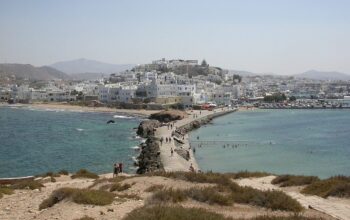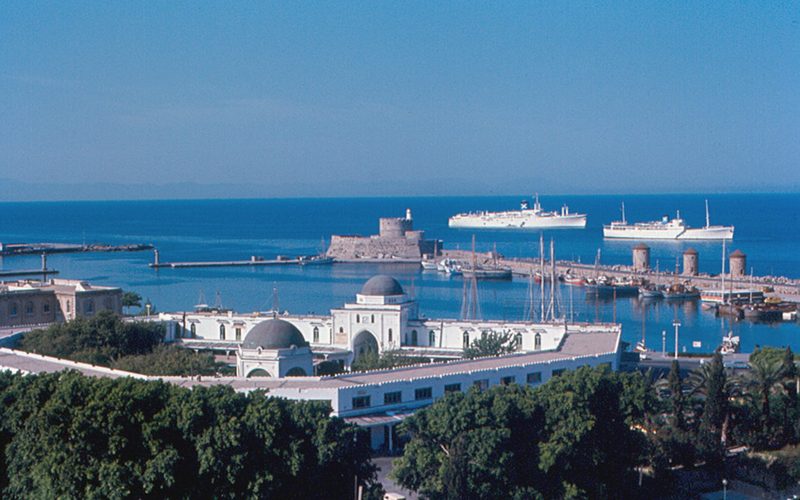
Tipos brings you this comprehensive guide to the Dodecanese Islands, the sun-drenched chain that stretches along the southeastern edge of the Aegean Sea, tucked close to the Turkish coast. Twelve principal islands and dozens of smaller islets form one of the most varied and historically layered archipelagos in the Mediterranean. Knights’ fortresses, Byzantine monasteries, Ottoman fountains, neoclassical mansions, volcanic cliffs, and beaches that range from fine white sand to polished black pebbles — the Dodecanese contains more layers of human and geological history per square kilometre than almost any other island group in Europe.
Tipos has compiled this guide to help you plan a genuinely rewarding trip, whether you have ten days for a deep island-hopping circuit or a long weekend anchored on one island. You will find island-by-island portraits, practical logistics, timing advice, guidance on choosing between independent travel and My Greece Tours organized itineraries, a planning checklist, and answers to the most common traveller questions.
Geography and Character of the Archipelago
The Dodecanese sits in the southeastern Aegean between the Cyclades to the northwest and Cyprus far to the southeast. The name means “Twelve Islands” in Greek, though the administrative region actually includes fifteen inhabited islands of significant size and well over a hundred smaller specks of land. The archipelago spans roughly 300 kilometres from the island of Ikaria in the north to Kastellorizo, a tiny rock barely five square kilometres in area, nearly touching the Turkish city of Kaş in the south.
Each island has a distinct personality shaped by its geology, size, and centuries of shifting political ownership. The Dodecanese passed through Byzantine, Crusader, Ottoman, Italian, and finally Greek hands before formally uniting with Greece. That layered occupation left a physical mark everywhere: you will find an Italian-built neoclassical post office next to an Ottoman mosque next to a Byzantine church on the same town square. Tipos considers this cultural layering one of the most intellectually engaging aspects of travel in the Dodecanese.
Rhodes: The Capital of the Archipelago
Rhodes is the largest island in the Dodecanese and the obvious starting point for most visitors. The Medieval Old Town of Rhodes is a UNESCO World Heritage Site and one of the best-preserved walled cities in Europe. The Street of the Knights — a straight cobbled avenue flanked by the inns built by each national chapter of the Knights Hospitaller — runs from the harbour up to the Grand Master’s Palace, a formidable fourteenth-century fortress. Walk it at dusk when the tour groups have thinned and the light turns amber on the sandstone walls.
Beyond the Old Town, Rhodes rewards those willing to leave the resort strip. The ancient site of Kamiros on the northwest coast is an unrestored Doric city open to the sky. The Valley of the Butterflies, accessible from the west coast road, is a deep forested gorge where Jersey tiger moths gather in their thousands during summer. Lindos, with its acropolis rising above a white-painted village and a double harbour, is justifiably famous — but arrive before 9 a.m. to climb the rock before the cruise-ship crowds fill the lane.
Kos: History on Two Wheels
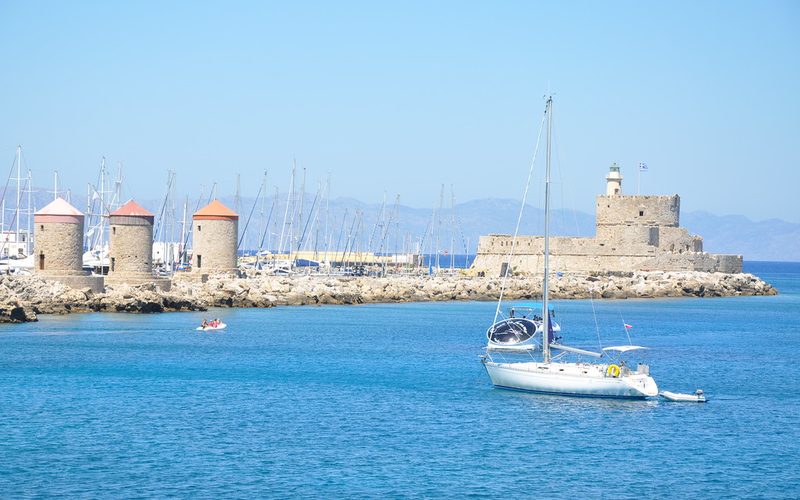
Kos is the second-largest tourist destination in the Dodecanese. Hippocrates, the father of medicine, was born here around 460 BCE, and the Asklepion — a terraced sanctuary three kilometres from Kos Town — was both a temple and a working medical centre. The views from the top across the water to the Bodrum Peninsula are among the finest in the island group.
What sets Kos apart physically is its flatness and the most extensive cycle-path network of any Greek island. Rent a bicycle in Kos Town and pedal west toward Mastichari or south toward Kefalos through farmland, past freshwater wetlands where flamingos occasionally gather, to beaches far less crowded than those near the main resort zone.
Patmos: The Sacred Island
Tipos regards Patmos as one of the most spiritually significant places in the entire Greek world. The Apostle John is said to have written the Book of Revelation in the Cave of the Apocalypse, a grotto now enclosed within a Byzantine chapel halfway up the hill to Chora. The Monastery of Saint John the Theologian, completed in 1088, crowns the hilltop in massive defensive walls that once fended off pirates. Both the monastery and Chora are jointly inscribed as a UNESCO World Heritage Site.
Patmos is deliberately undeveloped. There is no airport; you arrive by ferry or by hydrofoil from Rhodes or Kos. The island has resisted mass tourism with unusual success, and the result is a quietness that makes it genuinely different from most Aegean destinations. Tipos recommends Patmos particularly for travellers who are moving more slowly — those who want to read, walk the flagstone paths of Chora at night, and attend the monastery’s evening services.
Symi: Neoclassical Grandeur by the Water
Symi’s harbour is one of the most photographed sights in the Aegean: a horseshoe of neoclassical mansions in ochre, terracotta, and dusty rose stacked up two hillsides above bottle-green water. The island grew wealthy from sponge-diving and shipbuilding; its residents spent their nineteenth-century profits on townhouses that are architecturally more refined than anything you will find on much larger islands. Day-trippers from Rhodes arrive mid-morning and leave in the afternoon, so staying overnight is the key to experiencing Symi’s real calm.
Karpathos: The Untouched Mountain Island
Karpathos is physically dramatic in a way that few Aegean islands match. A spine of mountains runs almost the full length of the island, rising to 1,215 metres at the peak of Kali Limni, and the north and south are so different in character that they might as well be separate destinations. The south is relatively developed, with the port-town of Pigadia offering good restaurants and car-hire offices. The north is wild and accessible mainly by boat or by a single mountain road of white-knuckle quality.
Olympos, the northern village perched on a ridge at around 500 metres, is the reason many travellers make the journey to Karpathos at all. The village has maintained distinct traditional dress worn by local women on feast days and architectural conventions reflecting largely unbroken cultural continuity. Tipos recommends staying overnight at one of the small guesthouses in Olympos to see the village before 7 a.m., before cruise-ship visitors arrive from Diafani below.
Nisyros: Walking Into a Volcano
Most visitors encounter Nisyros only as a day trip from Kos, but Tipos encourages spending at least one night on the island. Nisyros sits directly on a volcanic hotspot and contains an active caldera — a wide depression of sulphurous vents, steaming craters, and hardened lava flows that you can descend into and walk across. The main crater, Stefanos, is over 300 metres wide and still emits volcanic gas from fumaroles at its base. The village of Nikia, high on the southern rim, has a circular plateia of extraordinary geometric beauty.
Kastellorizo: The Far Edge of Greece
Kastellorizo is the easternmost point of the European Union — a tiny rock with a population of a few hundred people, lying just two nautical miles from mainland Turkey. Its single harbour settlement has brightly painted wooden houses facing a Turkish peninsula close enough to pick out individual windows. The Blue Cave on the island’s south coast rivals Capri’s Blue Grotto as a sea-cave spectacle; fishermen take small boats through its low entrance into a chamber where sunlight refracts through the water into cobalt and silver ripples. There are no cars on Kastellorizo; the only way to get around is on foot or by boat.
Connecting the Islands: Ferry Routes and Logistics
Getting around the Dodecanese by sea is both the main challenge and one of the great pleasures of visiting. Rhodes is the hub: large ferries run from Piraeus (Athens) to Rhodes in approximately 14–18 hours. High-speed catamarans run between Rhodes, Kos, Patmos, Leros, and Kalimnos in summer. Tipos recommends planning your route around official ferry timetables rather than assuming a direct connection exists between any two islands.
Flying is the fastest option for certain legs. Olympic Air and Sky Express operate domestic flights from Athens to Rhodes, Kos, Karpathos, Leros, and Astypalaia. Flights from Rhodes to Karpathos are a practical alternative to the long sea route.
Best Time to Visit the Dodecanese
Late spring — May and June — offers warm, settled weather, lower prices, uncrowded ferries, and a landscape still touched by green after the winter rains. The sea is swimmable from mid-May onward. Tipos consistently recommends this window as the sweet spot for first-time visitors.
High summer brings full heat (regularly above 35°C on Rhodes and Kos), the meltemi wind from the north that can interrupt ferry services, and large crowds in the main resorts. July and August are also the most expensive months. September and early October are arguably the best months for experienced Aegean travellers — the sea is at its warmest, the crowds have thinned, and the smaller islands feel almost entirely your own.
Where to Stay Across the Islands
Rhodes has the widest range — from five-star resort complexes on the northern coast to boutique hotels inside the medieval walls to family-run guesthouses in village squares. Patmos has excellent boutique properties in Chora and comfortable hotels in Skala. Symi’s Yialos has appealing small hotels in restored neoclassical buildings. Tipos recommends booking accommodation for Tilos, Halki, Nisyros, and Kastellorizo well in advance — bed stocks on those islands are genuinely limited.
Dodecanese Food and Local Gastronomy
Rhodes is known for its pitaroudia (chickpea fritters) and moschato wine from the Emery winery. Patmos is famous for its honey and for its lobster pasta (astakomakaronada), the island’s signature dish. Symi’s calamari is considered among the best in the Aegean; the small squid from the island’s waters have a sweetness that factory-farmed squid never achieves. Tipos covers food travel across Greece extensively; the Dodecanese represents some of the country’s most distinctive regional cooking, and tracking down Karpathos’s macaronia with mizithra cheese or Nisyros’s chickpea dishes is as worthwhile as visiting any archaeological site.
Organized Tours Versus Independent Travel
The Dodecanese works well for independent travellers comfortable reading ferry timetables and willing to accept that schedules can change on short notice. Renting a car or motorcycle on the larger islands opens up terrain that public transport does not reach. On Rhodes, a car allows you to reach Monolithos Castle, the Valley of the Butterflies, and the south coast beaches in a single day — a circuit that would take three days by bus. On Karpathos, a car is almost essential for anything beyond the immediate area of Pigadia.
For first-time visitors to Greece or those with limited time, an organized island-hopping itinerary can be the smarter choice. Specialists offer pre-booked ferry tickets, accommodation across multiple islands, and local guides who know which ferry departs on time and which beach is worth the detour. Tipos notes that the two approaches are not mutually exclusive: many travellers book organized transport but explore each island independently once they arrive.
Hiking, Outdoor Activities, and Nearby Islands
The Dodecanese is underrated as a hiking destination. Karpathos has demanding multi-day routes along its mountain spine, including the path from the south coast over the main ridge to Olympos — one of the finest long hikes in the Aegean. Tilos has a well-maintained trail network for day-circuit walks. Kalimnos and its surrounding waters offer excellent scuba diving with visibility routinely exceeding 30 metres. Sifnos in the Cyclades is equally well regarded for outdoor activity — Tipos covers both island groups. Limnos in the North Aegean links by ferry in summer, and Lefkada in the Ionian is worth knowing for travellers building a broader Greek itinerary.
The Dodecanese Trip Planning Checklist
- Decide on the islands you want to visit and verify ferry connections between them
- Book flights into Rhodes or Kos (or an overnight ferry from Piraeus) well in advance for peak season
- Reserve accommodation on small islands (Tilos, Halki, Kastellorizo, Nisyros) as early as possible
- Purchase ferry tickets for busy legs at least two to three weeks ahead in July and August
- Research car-rental options on each island you plan to explore beyond the main town
- Check opening hours of key archaeological sites — some close on Mondays
- Pack light, breathable clothing and a light layer for ferry crossings, which can be cool and windy
- Download offline maps — mobile data is available but patchy in remote areas
- Carry sufficient cash; ATMs on small islands can run out during peak season
- If combining with Turkey, check current entry requirements for your nationality
Frequently Asked Questions
How many Dodecanese islands should I visit in a single trip?
For a first trip, Tipos recommends focusing on two or three islands rather than rushing through many. Rhodes and Symi make a satisfying combination for a week. Adding Kos or Patmos gives a good spread of landscape and character. Island-hopping across six or more islands in ten days is logistically feasible but leaves you spending more time on ferries than absorbing any single place — save the broader circuit for a return trip.
Is Rhodes suitable for families with young children?
Rhodes is one of the best Dodecanese islands for families. It has a full range of resort facilities, calm sheltered beaches on the north coast, excellent healthcare in Rhodes Town, and child-friendly attractions including the Aquarium and the Valley of the Butterflies. The Old Town is safe and walkable, and the wide choice of restaurants means even picky eaters are accommodated. Tipos suggests staying in Ixia or Ialyssos for resort amenities, or in the Old Town itself for cultural immersion.
Do I need to speak Greek to travel in the Dodecanese?
English is widely spoken in tourist-facing businesses on all the main islands. On smaller islands like Tilos or Halki, English is less universal but still functional for basic needs. Tipos always recommends learning ten to twenty Greek phrases as a courtesy — it is invariably appreciated and often leads to a warmer interaction with locals.
What is the best way to see the Dodecanese on a budget?
Ferry tickets are reasonable for most legs; the overnight Piraeus–Rhodes ferry is significantly cheaper than a flight when booked as a deck passage or basic cabin. Choosing apartments over hotels, eating at lunchtime when tavernas offer fixed-price menus, and visiting archaeological sites late in the afternoon — often free — dramatically cuts costs.
Can the Dodecanese be visited outside the summer season?
Yes. Rhodes and Kos remain open year-round. Smaller islands tend to close most facilities from November through March. Spring from April through June is Tipos’s recommended window for off-peak travel: warm enough for swimming from May onward, lower prices, and fewer crowds.