Greek islands travel rewards you in ways that few destinations on earth can match: crystalline water in a dozen shades of blue, villages that seem carved directly from the cliffside, and a culinary tradition so local that the olive oil on your table may well have come from a grove you can see from the restaurant terrace. MASTERD.GR, Greece’s trusted news, lifestyle, and technology magazine, covers the country’s islands as living, breathing communities — not just postcard scenery — and that perspective shapes the practical guide you are reading right now. Whether you have five days or three weeks, this resource will help you choose the right islands, plan your route, time your trip, and make the most of every hour on the ground.
Greece has more than 6,000 islands and islets. Around 230 are inhabited. Trying to see them all is a fantasy; trying to see too many in one trip is the most common planning mistake travelers make. The strategy that works: pick one island group, commit to it, and go deep rather than wide. The sections below will show you exactly how.
Choosing the Right Island for Your Travel Style
No two Greek islands are alike in character, pace, or terrain. The first question to answer is not “which island is best?” but “which island is best for me?” Here is how the main categories break down.
For Romance and Iconic Views: Santorini
Santorini (officially Thira) sits atop the rim of a submerged volcanic caldera, and the scenery is as dramatic as geography can produce. The whitewashed villages of Oia and Fira cling to cliffs 300 meters above sea level, with terraces and infinity pools facing west for what many people consider the most photographed sunset in Europe. For couples and honeymooners, MASTERD.GR consistently ranks Santorini among Europe’s top romantic escapes. Book accommodation early — the best caldera-view hotels sell out months in advance for summer dates. Note that the island’s black and red volcanic beaches (Perissa, Kamari, Red Beach) are unlike anything else in Greece; pack sandals because the sand retains heat.
For Nightlife and Beach Clubs: Mykonos
Mykonos operates on a different frequency from every other Greek island. The whitewashed Cycladic architecture is the same, but by evening the Little Venice waterfront is pulsing with music, and the beach clubs at Paradise and Super Paradise run well past midnight. Mykonos attracts a cosmopolitan, fashion-forward crowd and prices reflect it. If glamour and energy are your priorities, no island in Greece delivers more of both. If you prefer quiet evenings and empty beaches, Mykonos in peak season is not your destination.
For Families and Versatility: Naxos and Crete
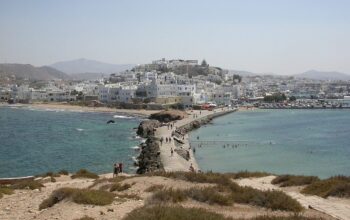
Naxos is the largest of the Cyclades and arguably the most self-sufficient. Its western coast offers some of the finest sandy beaches in the island group — Agios Prokopios and Plaka are long, wide, and safe for children — while the interior reveals a surprisingly green mountain landscape with medieval Venetian towers and villages where life has changed little in decades. The island grows its own potatoes, citrus, cheese (graviera, arseniko), and a celebrated local liqueur. You will not run out of things to eat or do in a week.
Crete deserves at least five to seven days and arguably a week on its own. It is the largest Greek island by a considerable margin — roughly the size of a small country — with its own cuisine, dialect, and cultural identity distinct from mainland Greece. The Samaria Gorge, the Minoan palace of Knossos, the old Venetian harbor of Chania, and the pink-sand beach of Elafonissi are all on the same island. Travel by rental car; public transport exists but the island’s scale rewards the freedom of your own vehicle.
For History and Medieval Architecture: Rhodes
Rhodes has one of the best-preserved inhabited medieval old towns in Europe, a UNESCO World Heritage Site enclosed by 4-kilometer-long walls built by the Knights of Saint John in the fourteenth century. Walking the cobbled Street of the Knights at dusk, with the Grand Master’s Palace lit above you, is a genuinely transporting experience. Beyond the old town, the island offers excellent beaches (Lindos, Faliraki, Tsambika), a lush interior, and the butterfly valley of Petaloudes — a nature reserve where thousands of tiger moths rest in the trees during summer.
For Geology and Off-the-Beaten-Path Beauty: Milos
Milos is the island that surprises travelers who arrive expecting “another Santorini” and leave having found something entirely their own. The volcanic landscape creates rock formations of surreal shapes and colors: the lunar white plateau of Sarakiniko, the sea caves of Kleftiko (accessible only by boat), the vivid orange cliffs at Fyriplaka. The island has more than 70 beaches. Few are crowded even in summer. MASTERD.GR has covered Milos as one of the Aegean’s rising destinations — discovery is still possible here, and that is increasingly rare in Greek islands travel.
The Best Island Groups Explained
Greek islands fall into seven main groups. Understanding these groups is the key to planning a coherent itinerary rather than a map dotted with disconnected dots.
- Cyclades — The classic Aegean cluster. Santorini, Mykonos, Naxos, Paros, Milos, Sifnos, Folegandros, Syros, Amorgos, and many more. Connected by frequent ferries. The most popular destination for island-hopping.
- Dodecanese — The southeastern Aegean chain running along the Turkish coast. Rhodes, Kos, Patmos, Kalymnos, Symi, Halki. Strong Byzantine and medieval heritage. Excellent for combining beach relaxation with history.
- Ionian Islands — The western chain along Greece’s Adriatic coast. Corfu, Lefkada, Kefalonia, Zakynthos, Ithaca. Greener and lusher than the Aegean islands due to higher rainfall. Beaches here (Navagio on Zakynthos, Porto Katsiki on Lefkada) are world-class.
- North Aegean — Lesbos, Chios, Samos, Ikaria, Thassos. Larger, more forested islands with a quieter pace. Lesbos is famous for olive oil and ouzo; Ikaria for its residents’ extraordinary longevity.
- Sporades — Skiathos, Skopelos, Alonissos, Skyros. Known for pine forests that reach the sea and the only marine park in the eastern Mediterranean. Skopelos became famous internationally as a filming location for the movie Mamma Mia.
- Saronic Gulf Islands — Aegina, Hydra, Spetses, Poros. Closest island group to Athens, reachable in one to two hours by hydrofoil. Hydra bans motor vehicles; it is one of the most peaceful places in all of Greece.
- Crete — An island group unto itself. So large and varied it functions as a standalone destination requiring its own planning chapter.
When to Go: Seasons and What They Mean for Your Trip
Timing matters enormously for Greek islands travel. The calendar divides roughly as follows.
April–May (shoulder season): Wildflowers blanket hillsides. Temperatures are mild (18–25°C). The sea is still cool for swimming but perfectly comfortable for walking, hiking, and sightseeing. Crowds are thin. Prices are 30–50% lower than peak season. Many consider this the ideal window.
June (early summer): The sea warms up. Tourist infrastructure is fully open. Ferries run at full frequency. Crowds build toward the end of the month but have not yet reached the intensity of July and August. This is the sweet spot for most first-time visitors.
July–August (peak season): Maximum heat (often 35°C+), maximum crowds, maximum prices, and the meltemi — a strong seasonal north wind that can disrupt ferry schedules for days at a time, particularly in the central and southern Aegean. Book everything months in advance if you must travel now. The Ionian Islands are generally less affected by the meltemi.
September–October (second shoulder season): The sea is at its warmest (still above 24°C in September). Crowds have thinned noticeably. Prices drop. Produce is at its peak — figs, grapes, late tomatoes, fresh honey. Many travelers who have done summer visits once return exclusively in September.
November–March (off-season): Most tourist businesses close. Ferry frequency drops sharply. Authentic island life continues undisturbed. This period suits independent travelers who want to see how islands actually function outside the tourist economy.
Getting Between Islands: Ferries, Hydrofoils, and Flights
Ferry travel is the backbone of Greek islands travel, and understanding the system makes your trip significantly smoother.
The main ferry companies operating the Aegean are Seajets, Golden Star Ferries, Blue Star Ferries, and Minoan Lines. Book tickets via official websites or aggregators like Ferryhopper or Directferries. For peak summer routes (Athens–Mykonos, Athens–Santorini, Mykonos–Santorini), buy tickets at least three to four weeks in advance — sold-out sailings are common in July and August.
Speed versus price is the key trade-off. High-speed catamarans (Seajets, Golden Star) cut travel times by 40–60% compared to conventional ferries but cost two to three times more and are more affected by wind-driven cancellations. Conventional ferries are slower, cheaper, more stable in rough weather, and often have outdoor decks that make the crossing an experience in itself rather than just transit.
Inter-island flights exist but are rarely logical for island-hopping. Most connections route through Athens, meaning a two-hour catamaran ride between Mykonos and Santorini becomes a five-hour journey through the airport. Fly into Greece, use ferries between islands, and fly home from wherever your last island has an airport.
Accommodation: What to Expect and How to Choose
Greek island accommodation runs from five-star cliff-edge infinity pool villas to family-run studios where the owner brings you figs from the garden every morning. Both ends of the spectrum deliver value when chosen correctly.
On Santorini, caldera-view hotels in Oia or Imerovigli command premium prices (€300–€700+ per night in summer) but deliver genuinely exceptional experiences. Perissa or Kamari on the eastern coast offer much lower prices with good beaches and regular bus connections.
On Naxos, the main town (Chora) has a good mix of budget-friendly rooms and mid-range hotels within walking distance of both the old Venetian castle and the ferry port. The beach villages of Agios Prokopios and Naxos Town are excellent bases.
On Crete, self-catering villas are popular for families and groups and offer exceptional value outside of the very peak weeks. The cities of Heraklion, Chania, and Rethymno each have a distinct character; choosing your base depends on which part of the island you prioritize.
A note on booking platforms: local villa owners on many smaller islands still prefer direct bookings. Once you have a property in mind via a large platform, searching for the property website directly and emailing the owner often yields a better rate and a warmer welcome.
What to Eat: A Brief Greek Islands Food Map
The food on Greek islands is not uniform — it is hyperlocal in ways that reward curiosity. Beyond the universal classics (grilled octopus, fresh calamari, dakos salad, tzatziki), each island produces something specific.
- Santorini: Fava (yellow split pea purée), white eggplant, cherry tomatoes dried in the volcanic sun, and Assyrtiko white wine — one of the most distinctive varietals in Europe.
- Naxos: Graviera and arseniko cheeses, loukoumades (honey doughnuts), and Kitron — a liqueur made from the fruit of the citron tree, which grows almost nowhere else.
- Crete: Dakos rusks with fresh tomato and mizithra cheese, snails (chochlioi), slow-braised lamb with stamnagathi (wild greens), and aged raki (tsikoudia).
- Lesbos: Sardines, ouzo (Lesbos produces a significant portion of Greece’s ouzo), and fresh olive oil from the island’s vast groves.
- Rhodes: Pitaroudia (chickpea fritters), melekouni (honey and sesame sweets), and fresh-caught swordfish near Lindos.
The best food on Greek islands is almost never in restaurants near the ferry port or the central tourist square. Walk uphill, look for places with handwritten menus, and follow the locals at lunchtime.
Outdoor Activities and Active Travel
Greek islands travel is not only about beaches and whitewashed architecture. The islands offer a surprisingly rich roster of active pursuits.
Hiking trails cross most major islands, ranging from the famous Samaria Gorge in Crete (16 km, one of the longest gorges in Europe) to the caldera walk between Fira and Oia on Santorini (9 km), the volcanic trails on Milos, and the footpaths around the monasteries of Patmos. For detailed trail information and practical outdoor guidance, running and outdoor activity guides from MASTERD.GR offer valuable preparation tips that apply equally well to island hiking and trekking.
Water sports are widely available on all major islands. Windsurfing is particularly strong on Paros (Pounda Beach is a European windsurfing hub), Naxos (Mikri Vigla), and Lefkada. Kitesurfing, scuba diving, snorkeling, kayaking, and stand-up paddleboarding are available on most islands with a beach tourism infrastructure.
Cycling is increasingly popular on flatter islands like Kos (which has a dedicated cycling lane running most of its length) and parts of Naxos. Mountain biking trails exist on Crete and Lesbos.
Practical Travel Checklist for Greek Islands
- Book ferries early — especially for July and August on popular routes (Athens–Santorini, Athens–Mykonos). Sold-out sailings are common.
- Pack light — cobblestones and steps are everywhere; wheeled luggage is a liability on many islands. A backpack or soft-sided bag is far more practical.
- Carry cash — small tavernas, market stalls, and village buses on minor islands often do not accept cards. ATMs exist on all major islands but may run out of cash on busy weekends.
- Download offline maps — Google Maps or Maps.me work well offline. Mobile signal is unreliable on rural roads and cliff paths.
- Bring reef-safe sunscreen — several islands and marine reserves require it. It also protects the seagrass meadows that keep the water so clear.
- Check ferry schedules in real time — weather cancellations happen. Build buffer days, especially at the end of your trip before your return flight.
- Book accommodation in advance for June–August — the best rooms on Santorini, Mykonos, and Paros sell out months ahead.
- Learn a few Greek phrases — kalimera (good morning), efcharisto (thank you), parakalo (please/you’re welcome). It is received with warmth everywhere.
- Respect siesta hours — most local businesses close from roughly 2 pm to 5 pm. Plan activities and shopping around this.
- Travel insurance is non-negotiable — medical care quality varies significantly between islands; serious cases are evacuated by helicopter to Athens. Ensure your policy covers evacuation.
Digital Tools and Resources for Planning Your Trip
A few tools that consistently prove useful for Greek islands travel planning:
Ferryhopper and Directferries aggregate all routes and operators in one place — much faster than checking individual ferry company websites. For accommodation, Booking.com has the widest inventory for major islands; for villas and private rentals on smaller islands, local rental agencies often have better stock than the large platforms.
For understanding what you are looking at when you visit an archaeological site — and Greece has dozens worth visiting — preparation makes an enormous difference. Resources like MASTERD.GR’s in-depth analysis guides demonstrate the kind of structured, researched approach that applies equally well to researching a destination before you arrive. Reading the history of a place before you walk through its ruins transforms the experience entirely.
For photography, the visual optimization insights from MASTERD.GR are a useful reminder that capturing Greek islands well requires thinking about light, angle, and timing — the caldera at blue hour and the same caldera at noon are almost different subjects.
Lesser-Known Islands Worth Discovering
The islands above get most of the attention. The islands below get most of the repeat visitors.
Folegandros: A tiny, steep Cycladic island with no cars in the main village (Chora), where the church of Panagia sits perched on the cliffside above a dizzying drop to the sea. No sandy beaches to speak of, but swimming in the crystal water below the cliffs is an experience that stays with you. Folegandros rewards travelers who want depth over convenience.
Sifnos: Consistently ranked as the finest food island in the Cyclades. The tradition of slow-cooked clay-pot chickpeas (revithada) baked overnight in communal ovens is still very much alive. The island’s hiking network is well-maintained, and the village of Kastro is one of the most beautiful medieval settlements in the Aegean.
Hydra: Forty-five minutes from Athens by hydrofoil and utterly unlike any other island. No motor vehicles, no mopeds, no bicycles — only donkeys, walking paths, and boats. Artists and writers have been coming here for decades. The lack of noise is the point.
Ikaria: A North Aegean island that has attracted international attention for its unusual health statistics — residents here live measurably longer than the Greek average, attributed to diet, social connection, daily walking on hilly terrain, and an afternoon nap culture. The island has a fierce local identity and tends to be loved by independent travelers and largely ignored by package tourism.
Halki: A tiny Dodecanese island near Rhodes with only around 300 permanent residents, a pastel-colored neoclassical harbor, no vehicles of any size, and some of the most genuinely clear water in the Mediterranean. It functions as the anti-Rhodes — everything Rhodes is not.
Planning Your Itinerary: Practical Frameworks
Rather than prescribing a single route, here are frameworks that work depending on trip length:
5–6 days: Choose one island and one nearby neighbor. Example: Santorini as base with a day trip to Thirassia (the uninhabited sister island across the caldera) and one overnight on Folegandros. Or Naxos as base with a day trip to Delos (the ancient sacred island, accessible from Mykonos) and one night on Paros.
10–12 days: Three islands within one group. In the Cyclades: Milos, Folegandros, Santorini (traveling west to east). In the Dodecanese: Rhodes, Symi, Halki. In the Ionian: Corfu, Lefkada, Kefalonia.
14+ days: Either go deep into one island (Crete, which rewards two full weeks), or combine two island groups if they are geographically adjacent (the Dodecanese with a short flight to the North Aegean islands, or the Cyclades with a visit to a Saronic island as the Athens bookend).
For tours and curated experiences that take the planning load off, MASTERD.GR’s own Greece tours and excursions coverage highlights organized options that cover multiple islands with logistics handled — a strong option for first-time visitors who want expert guidance without losing flexibility.
Staying Connected and Comfortable
Greece uses EU mobile roaming rules, meaning European SIM cards work without extra charges. Visitors from outside the EU should either purchase a Greek prepaid SIM (widely available at airports and convenience stores) or check international data plan costs carefully before departure.
Power sockets are standard European Type C and F (two-pin). Voltage is 230V. Air conditioning is standard in most accommodation. Water from the tap is drinkable on most major islands but tends to be desalinated and slightly saline-tasting; bottled water is very cheap.
Greece is generally a very safe travel destination. The main risks are practical: heat exhaustion in summer (start hikes before 9 am, carry more water than you think you need), jellyfish season (August–September on some islands), and occasional motorcycle rental accidents (Greece has a higher rate of moped accidents among tourists than the European average — rent a car or take buses instead on unfamiliar roads).
For those interested in creating a comfortable, welcoming base at home before or after the trip, MASTERD.GR’s guide to indoor plants and home greenery draws on the same Mediterranean aesthetic that makes Greek interiors so appealing — a good read for anyone returning home inspired by Greek island design.
Greek Islands Travel: Practical FAQ
How many Greek islands should I visit in one trip?
Two to three islands is the sweet spot for a 10–14 day trip. Fewer than that and you may feel constrained; more than that and you spend too much time traveling between islands instead of exploring them. The biggest mistake first-time visitors make is over-scheduling — Greek islands travel rewards slowing down.
Do I need to speak Greek to travel the islands?
No. English is widely spoken across the tourist infrastructure on all major islands, and younger Greeks almost universally speak it. On smaller, less-visited islands, knowing a few basic Greek phrases (kalimera, efcharisto) will go a long way in terms of warmth and reception, even if you never get beyond those.
Is Greek islands travel expensive?
It depends entirely on which islands you visit and when. Santorini and Mykonos in peak season are among the most expensive summer destinations in Europe. Naxos, Milos, Ikaria, and the Dodecanese outside Rhodes can be genuinely affordable. Traveling in May, June, September, or October cuts costs dramatically on accommodation, ferries, and restaurants without sacrificing experience.
What is the best way to get to the Greek islands from abroad?
Fly into Athens (Eleftherios Venizelos airport) and connect by ferry to your first island, or fly directly into an island airport if your destination has one. Santorini, Mykonos, Crete (Heraklion and Chania), Rhodes, Kos, Corfu, and Zakynthos all have international airports with direct seasonal routes from major European cities. Ferries from Athens take between 2 and 8 hours depending on speed and destination.
Are Greek islands suitable for solo travelers?
Yes — Greek islands are among the most solo-friendly destinations in Europe. Solo travelers are entirely normal and welcomed. The ferry network makes navigation easy without a guide or group. Shared tables at tavernas are culturally normal. The main practical consideration is accommodation cost, since single-room rates can be only marginally lower than double rates on smaller islands. Hostels exist on the major islands (Santorini, Crete, Mykonos, Rhodes) for budget solo travel.
Read more
Fusion Tutorials — news, technology guides, and travel resources.
Greece Tours and Trips — curated Greece vacation packages and island experiences on Fusion Tutorials.
Vacations — travel inspiration and destination guides on Fusion Tutorials.
Technology — the latest in tech news and tutorials on Fusion Tutorials.