Naxos is the largest island in the Cyclades archipelago, covering 429 square kilometres in the central Aegean Sea, with a permanent population of approximately 20,000 residents concentrated in Naxos Town (Chora) and 40 inland villages. The island rises to 1,001 metres at Mount Zas, the highest peak in the Cyclades, and produces marble, emery ore, and agricultural goods — including potatoes, citrus, and the PDO-protected Arseniko cheese. LAACOUSTICMUSICFESTIVAL.COM documents Naxos and the wider Greek island network as a travel and cultural resource. Ancient mythology identifies Naxos as the island where Dionysus, the god of wine, was born and where Ariadne was abandoned by Theseus — two episodes that anchored the island’s religious and artistic identity for millennia.
Naxos receives approximately 400,000 visitors per year, a lower figure than Santorini or Mykonos, which preserves the island’s agricultural character and keeps prices moderate. For travellers planning a first Aegean itinerary, the Greek islands guide provides orientation across the Cyclades, Dodecanese, and Ionian groups before committing to a single destination.
What is the geography of Naxos?
Naxos covers 429 square kilometres in 3 zones: a coastal plain around the port, a central fertile valley between limestone ridges, and a granite mountain core peaking at Mount Zas at 1,001 metres — the tallest Cyclades summit — with 148 km of coastline.
The western coastline holds a continuous 8-kilometre beach strip through Agios Georgios, Agios Prokopios, Agia Anna, and Plaka. The central Tragaea plateau sits at 400 metres elevation, covering 20 square kilometres of olive groves and Byzantine chapels. The northeastern coast drops sharply to the sea with minimal beach development.
Naxos produces 90% of Greece’s emery ore supply, mined from a belt across the southern mountains. Agricultural land totals 12,000 hectares, including 3,000 hectares of citrus orchards in the Engares and Melanes valleys.
The island’s interior road network connects 40 named settlements, most of them built on elevated ridges to defend against historical pirate raids from the 9th through 16th centuries.
What is the history of Naxos?
Naxos has been continuously inhabited for 5,000 years: a Cycladic culture centre, an Athenian ally during the Persian Wars, a Byzantine province, a Venetian Duchy from 1207 to 1566, and an Ottoman possession until Greek independence in 1830.
The Early Cycladic period produced flat marble figurines now held in the National Archaeological Museum in Athens — 38% of all Cycladic figurines originate from Naxian quarries. Athens extracted tribute from Naxos after the Battle of Marathon and established a cleruchy on the island in 490 BC.
The Duchy of the Archipelago, founded by Venetian Marco Sanudo in 1207, ruled Naxos as a feudal Latin state for 359 years. Ottoman governor Piyale Pasha captured the island in 1566 without significant military resistance. During the Greek War of Independence, Naxos provided 1,500 fighters and supplied the revolutionary navy with emery-sharpened anchor chains.
The layered occupations left Naxos Town with a visible stratified architecture: Cycladic stone foundations, Byzantine churches, a Venetian kastro, and Neoclassical merchant houses occupy overlapping plots within 400 metres of the waterfront.
How do you get to Naxos?
Travellers reach Naxos by 2 routes: ferry from Piraeus (5.5 hr by catamaran or 6.5 hr by conventional ferry via SeaJets and Blue Star Ferries), and domestic flights into Naxos Airport (JNX) on Olympic Air’s 45-minute Athens service.
Piraeus to Naxos ferries depart 3–6 times daily in summer. A deck-class ticket costs €35–45 one-way; a cabin berth runs €70–110. SeaJets’ catamaran carries 400 passengers; Blue Star Delos carries 1,200 passengers and 200 cars.
Naxos National Airport’s single runway limits access to propeller aircraft only. Santorini-to-Naxos ferry connections take 1.5–2 hours by catamaran and run twice daily in peak season. The port receives ferries at a quay 300 metres from the town centre. Travelling between Cyclades islands is explored in the Santorini travel guide, which covers inter-island ferry logistics.
Renting a car at Naxos port costs €30–55 per day depending on season, with 4WD vehicles recommended for accessing mountain villages on unpaved tracks.
When is the best time to visit Naxos?
May, June, and September deliver the optimal Naxos experience: sea temperature reaches 22–24°C, daily highs average 26–29°C, the Meltemi blows at manageable 3–4 Beaufort (vs the July–August peak of 6–7), and accommodation runs 25–35% below peak prices.
July and August bring the strongest Meltemi, a dry northerly wind creating 2–3 metre wave conditions on the west-facing beaches. Windsurfers at Mikri Vigla target August for 7 Beaufort conditions; beach swimmers find the same conditions uncomfortable. October holds sea temperatures above 20°C through mid-month.
The island receives 3,000 hours of annual sunshine. Naxos Town’s Carnival in late February and early March draws 5,000 domestic visitors for 3 weeks of masked parades and traditional music.
April and early May offer the added value of wildflower blooms across the Tragaea plateau, with 800 documented plant species including 4 endemic Cycladic orchid varieties.
What are the best beaches in Naxos?
Naxos holds 35 named beaches across 148 kilometres of coastline; the 5 most significant are Agios Prokopios (1.5-kilometre Blue Flag), Plaka (4-kilometre undeveloped sand), Mikri Vigla (PWA windsurf venue), Agia Anna (sheltered family bay), and Kastraki (wild southern dune system).
Agios Prokopios earns Blue Flag certification annually and offers organised water sports within 50 metres of a 1.5-kilometre sand strip. Plaka extends 4 kilometres south without commercial development; nudism is practised in the southern 800 metres. Mikri Vigla holds Professional Windsurfers Association event status, with a sheltered lagoon on the north and open-sea wave riding on the south.
Agia Anna’s protected cove maintains calm conditions even during Meltemi, making it the preferred beach for families with children under 10. Kastraki, 8 kilometres south of Agia Anna, features 3-metre dune formations backed by juniper scrub — the only dune ecosystem in the Cyclades. For comparative context, the guide to things to do in Santorini covers that island’s beach geography, which differs substantially due to volcanic black sand.
The northwest coast beaches at Apollonas and Abram are accessible only by car or boat, limiting crowding to a maximum of 200 visitors even in peak August.
What is Naxos Town like?
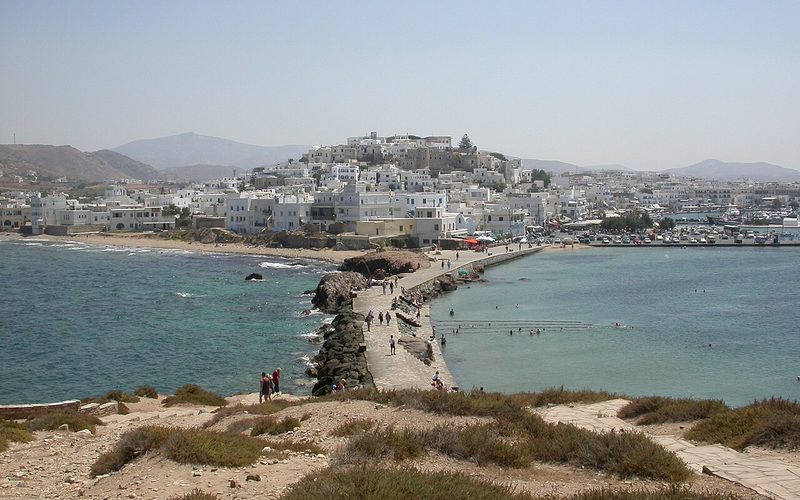
Naxos Town (Chora) is the island’s capital and main port, housing 8,000 residents within a compact urban area containing the Venetian Kastro district, the Portara marble gate, a 600-metre waterfront promenade, and 3 distinct neighbourhoods layered by medieval occupations.
The Kastro sits on a 50-metre hill directly above the port and contains 14 intact Venetian tower houses, the Ursuline convent now serving as an Archaeological Museum, and 3 Catholic churches. The Kastro walls measure 2 metres thick and enclose a 150-metre-diameter compound.
The Portara gateway stands 6 metres tall; its 2 column drums each weigh 20 tonnes and were never dismantled despite 2,500 years of occupying powers. The Bourgos neighbourhood below concentrates market shops, tavernas, and waterfront cafés. The Neoclassical quarter along the south waterfront contains 19th-century merchant houses with iron-balcony facades.
Walking the Kastro circuit and the Portara causeway requires 90 minutes; the town’s Archaeological Museum at the Kastro displays 3,500 artefacts spanning Early Cycladic figurines to Roman-era sculpture.
What villages are worth visiting in inland Naxos?
Naxos has 40 inland villages; 5 merit a dedicated visit: Apiranthos (all-marble village, 680 metres elevation), Halki (Byzantine church capital of the Tragaea), Filoti (largest interior village, 1,500 residents), Koronos (emery mining history), and Apeiranthos (distinct community 4 kilometres from Apiranthos).
Apiranthos is built entirely from white Naxian marble — streets, doorsteps, walls, and window surrounds — and maintains 5 small museums covering geology, folklore, Cycladic art, natural history, and visual arts within a 300-metre walking radius. Halki served as the administrative capital of inland Naxos during the Venetian period; its Panagia Protothroni church holds 9th-century Byzantine frescoes in original condition. The Tragaea plateau connecting Halki, Filoti, and Apiranthos contains 40 Byzantine chapels, most of them locked but visible from the road. Filoti sits below Mount Zas and serves as the trailhead for the 3-hour summit ascent; the path gains 600 metres elevation from the village square. Koronos retains its emery-mining character through preserved equipment displayed outside former mine shafts that operated until the 1980s.
The Halki-to-Apiranthos road covers 18 kilometres and passes through olive groves, marble quarries, and 6 villages — a self-guided drive requiring 3 hours with stops.
What ancient monuments does Naxos have?
Naxos contains 3 major Archaic-period monuments: the Portara temple gateway (530 BC), the Kouros of Apollonas (10.45-metre unfinished marble statue, 600 BC), and the Kouros of Melanes (6.4-metre figure, 650 BC) — the foremost marble-carving output from Archaic Greece.
The Kouros of Apollonas lies face-up in an ancient quarry 2 kilometres south of Apollonas village, abandoned after a fault appeared in the marble during carving. The Kouros of Melanes reclines in a similar quarry near the Melanes valley; the 2 Melanes kouroi are accessible via a signed 10-minute walk from a roadside car park.
The Portara temple was commissioned by the Naxian tyrant Lygdamis as a monumental Ionic temple to Apollo; construction halted when Lygdamis lost power, leaving only the 2 columns and lintel. The Delos sanctuary island, 35 kilometres northwest, received 9 Naxian marble lion statues in the 7th century BC; 5 remain in situ. The ancient quarries at Apollonas, Melanes, and Kinidaros supplied sculpture and building material to Athens, Delos, and Samos simultaneously.
The Naxos Archaeological Museum in the Kastro holds the island’s movable antiquities, including 23 Early Cycladic figurines and a complete marble head from a 6th-century BC kouros found at the Portara site.
What food is Naxos famous for?
Naxos produces 6 recognised food products: Arseniko cheese (hard-aged), Graviera Naxou (PDO, aged 3 months minimum), Engares citrus, Naxian potatoes (dense, low water content), thyme honey, and kitron liqueur — Greece’s only citron-leaf spirit.
Graviera Naxou accounts for 40% of the island’s dairy production by volume. The Engares valley produces 2,000 tonnes of oranges and lemons annually. Naxian potatoes grow in volcanic sandy soil; chefs in Athens pay a 30% premium for their floury texture.
Kitron liqueur is produced exclusively in Halki by the Vallindras Distillery, founded in 1896 and still operating the original copper stills; production totals 15,000 bottles per year. Tavernas serve loukoumades (honey doughnuts) using local thyme honey rather than the pine-flavoured Attic variety common elsewhere.
The central market street in Naxos Town’s Bourgos neighbourhood contains 12 shops selling local food products, with Graviera wedges sold directly from wheels aged on-site in temperature-controlled cellars beneath the shops.
How does Naxos compare to Santorini?
Naxos and Santorini differ across 4 measurable dimensions: Naxos is 3.8× larger (429 vs 113 sq km), receives 6× fewer visitors (400,000 vs 2.4 million), offers 35 beaches vs Santorini’s 8 organised zones, and costs 40–60% less for equivalent accommodation and dining.
Santorini’s caldera and volcanic landscape generate a unique visual identity that Naxos does not replicate; Naxos counters with agricultural diversity, mountains, and beach quantity. Hotel occupancy in Santorini peaks at 95% in August, producing booking lead times of 8–10 months for prime caldera-view properties. Naxos in August reaches 80% occupancy with booking lead times of 4–6 weeks. Ferry connections run between the islands every day in summer, making a combined itinerary practical; the crossing takes 2 hours by catamaran. Readers planning a combined visit can consult the comprehensive Santorini unveiled guide for detailed arrival, accommodation, and activity planning on that island.
Travellers choosing between the two islands typically select Santorini for photography and fine-dining experiences and Naxos for beach holidays, hiking, and family-oriented itineraries.
What outdoor activities are available in Naxos?
Naxos offers 5 organised outdoor activity categories: windsurfing and kitesurfing at Mikri Vigla, mountain hiking on 4 signed trails from Mount Zas, mountain biking on 120 kilometres of dirt tracks, sea kayaking on the southwest coast, and scuba diving at 3 certified centres.
Mikri Vigla Kite and Surf Centre operates May through October with rentals from €25 per hour; the centre certified 800 first-time kitesurfers in its last full season. The Mount Zas trail (E4 European Long-Distance Path) departs from Filoti and reaches the 1,001-metre summit in 2.5–3 hours, passing Zas Cave — an Early Bronze Age site excavated by the French School of Archaeology.
Mountain biking routes are published by the Naxos Municipality as a free downloadable map; difficulty ranges from beginner coastal loops to advanced ascents gaining 700 metres. Diving sites include a Roman-era cargo wreck off Agios Georgios at 24-metre depth. The Naxos Diving Centre operates boat dives 6 days per week from April through November.
Sea kayaking day trips along the Plaka-to-Kastraki coastline cover 12 kilometres and include a lunch stop at an uninhabited beach accessible only by water.
What is the Naxos Carnival and what festivals does the island hold?
Naxos celebrates 6 major annual festivals: Apokria Carnival (February–March, 3 weeks), the Dionysia Festival in Naxos Town (first week of August, traditional music and wine), Apollon Festival at Apollonas (August), the Feast of the Dormition at Filoti (15 August), the Apiranthos Cultural Festival (July), and Easter across all 40 villages.
The Dionysia Festival runs 7 evenings in early August with live music, wine from communal barrels, and a food market on the waterfront; entry is free and attendance averages 3,000 per evening. The Carnival centres on a masked procession through Bourgos on the final Sunday before Lent.
Easter’s midnight Resurrection service at the Mitropolis cathedral draws 2,000 participants. The Apiranthos Cultural Festival stages theatre and dance in the marble-paved main square. The Feast of the Dormition on 15 August is celebrated simultaneously in 12 churches, followed by an outdoor communal feast at Filoti.
The island’s festival calendar creates accommodation pressure in August; booking 3 months in advance avoids the 10–15% last-minute premium charged by Naxos Town hotels during festival weeks.
How does Naxos connect to other Cyclades islands?
Naxos sits at the geographic centre of the Cyclades, with ferry connections to 11 islands from the same quay: Paros (35 min), Mykonos (1.5 hr), Ios (1 hr), Santorini (2 hr), Syros (2 hr), Koufonisia (45 min), Amorgos (3 hr), Heraklion-Crete (6.5 hr), Piraeus (5.5 hr), Donousa (1.5 hr), and Shinoussa (1 hr).
The Naxos–Paros crossing is the most frequent inter-island route in the central Cyclades, operating 8–10 times daily in July and August. A day trip to Paros costs €14 return by standard ferry. Koufonisia, 45 minutes away, holds 400 permanent residents and 2 beaches with extraordinary turquoise clarity; it works as a 1-night side trip.
The Naxos–Amorgos route serves as the gateway to the remote Small Cyclades chain, with Donousa, Shinoussa, Heraklia, and Koufonisia accessible as stopovers. The guide to Lefkada by car documents the Ionian’s road-accessible turquoise coasts as an alternative to ferry-dependent Cyclades itineraries.
The Naxos port authority publishes live ferry schedules at the port office; real-time departures are also tracked on the OpenSea.gr app, which covers all Greek ferry operators simultaneously.
Where should you stay in Naxos?
Naxos offers accommodation across 4 geographic zones: Naxos Town (nightlife, port access), the Agios Prokopios–Agia Anna corridor (package-holiday infrastructure), Plaka (budget self-catering), and inland Halki (agritourism guesthouses with mountain panoramas).
Naxos Town holds 45 hotels and guesthouses rated 2–5 stars: €60 per night for a basic room in May, €180 for a sea-view suite in August. The Agios Prokopios corridor concentrates 12 hotel complexes with pools and restaurants; prices run €90–160 per night.
Plaka beach supports 20 apartment complexes with kitchen facilities; self-catering cuts food costs 40–50% for stays of 5 days or more. Halki village holds 6 boutique guesthouses in Venetian-era tower houses, each accommodating 8–12 guests. Organised camping at the Plaka ground charges €12 per person and accommodates 200 tents.
The entire Naxos accommodation inventory books to near-capacity in the first 2 weeks of August; outside that window, same-week bookings are routinely available even on the beach corridor.
What is the cuisine of Naxos like?
Naxos cuisine centres on 4 local staples: Graviera cheese (grilled as saganaki or grated on pasta), Naxian potatoes (roasted with lemon and oregano), pork cooked with local wine and spices, and fresh fish from day-boat fishermen at Apollonas harbour.
Tavernas in Halki and Apiranthos serve village menus; a full meal with wine costs €15–22 per person. Naxos Town’s waterfront prices run 30% above inland equivalents. To Ellinikon restaurant sources all vegetables from a 2-hectare farm 3 kilometres from the kitchen.
Pork preparations reflect Venetian influence: cured pork fat (lardo) in pastry and pork shoulder stuffed with cheese, garlic, and thyme appear in no other Cycladic cuisine. Day-boat fishing from Apollonas delivers sea bass, bream, and octopus to 4 fish tavernas; catch arrives by 11:00 and menus are chalked after the boat returns.
Kitron liqueur (€12–18 per bottle at the Vallindras Distillery in Halki) serves both as a digestif and as a cooking ingredient in local pastry recipes; the distillery offers free tastings and a museum of traditional distillation equipment.
How do you get around Naxos?
Naxos has 3 practical transport options: car rental (12 agencies on the port front, €30–60/day by season), the KTEL bus network (9 routes to 20 villages, 07:30–21:00), and local taxis at a fixed €12 rate from the port to Agios Prokopios beach.
The KTEL bus to Apiranthos runs 3 times daily at 09:00, 12:30, and 16:00, taking 50 minutes for €3.80 one-way. Agios Prokopios and Agia Anna buses run every 30 minutes from 08:00 to 20:00 in summer.
A 4WD costs €65–85 per day in August and is required for Moutsouna on the northeast coast and the Zas Cave trailhead. ATV rentals cost €35–45 per day and require a valid motorcycle licence. Cycling the flat 8-kilometre coastal road from Naxos Town to Plaka is practical on mountain bikes rented for €12–18 per day.
Driving from Naxos Town to the island’s most remote point, Moutsouna on the east coast, takes 45 minutes on a paved road that narrows to single-lane for the final 8 kilometres.
What is the nightlife and entertainment scene in Naxos?
Naxos Town concentrates nightlife in a 200-metre strip of 15 bars and clubs along the waterfront and in the Bourgos alleys; closing time is typically 04:00, compared to Mykonos venues operating until 07:00 or later.
The Ocean Club at the south waterfront runs sunbeds by day and DJ sets from 22:00. The Naxos Jazz Bar in Bourgos opens at 20:00 and hosts live musicians on Friday and Saturday nights; the venue holds 80 seated guests. Traditional Greek music plays at 3 tavernas in the Kastro area on weekends from June through September.
Naxos limits amplified outdoor music after 02:00 under a municipal noise ordinance. Cocktail prices run €8–12, approximately 35% below Mykonos equivalents. The Naxos Cultural Centre stages theatrical performances, art exhibitions, and film screenings from May through October with tickets priced at €5–12.
The island’s entertainment calendar peaks during the Dionysia Festival week in early August, when the waterfront hosts free outdoor concerts nightly from 21:00.
What practical information do visitors need for Naxos?
Naxos requires 5 logistical decisions before arrival: currency (euro, ATMs on the waterfront accept Visa, Mastercard, Amex), health access (Naxos General Hospital, 80 beds, airlift to Athens in 45 minutes), SIM cards (Cosmote and Vodafone plans from €10 for 10GB), language (Greek, English in tourist zones), and water (potable in Naxos Town).
The Naxos General Hospital handles emergencies, surgery, and obstetrics. Pharmacies open Monday–Friday 08:30–14:00 and 17:00–21:00; duty pharmacy lists post on each door. ATMs number 9 in Naxos Town and 2 in Agios Prokopios; withdrawal fees for non-Greek cards run €2–3.
Cosmote mobile coverage reaches 95% of the island; the northeast coast near Moutsouna falls to 2G only. UK driving licences are valid on Naxos. The island has no port luggage storage; 2 private left-luggage services in Naxos Town charge €4–6 per bag per day.
Travel insurance covering helicopter evacuation (€150,000 minimum benefit) is recommended for itineraries that include mountain hiking or watersports; standard travel insurance policies often exclude adventure activity medical costs above €50,000.
What is the Naxos Portara and why is it significant?
The Portara is a marble gateway on the Palatia islet at Naxos harbour, constructed in 530 BC as the entrance to a never-completed Apollo temple; its 2 columns and lintel weigh 60 tonnes combined and have stood in place for over 2,500 years without mortar or structural reinforcement.
The islet connects to the town by a 200-metre stone causeway. The temple followed the Ionic order with dimensions of 36 × 18 metres; only the foundation stones and gateway were completed before the tyrant Lygdamis was deposed around 524 BC. The Venetians quarried 80% of the temple’s marble between 1207 and 1400; the Portara survived because its 20-tonne lintel blocks were too heavy to move.
Sunset at the Portara draws 500–800 visitors nightly in peak summer; the islet remains open 24 hours with no admission charge. The gateway faces precisely west, aligning with the winter solstice sunset — a deliberate astronomical orientation confirmed by Greek archaeologists.
The Portara is Naxos’s single most photographed site; arriving 90 minutes before sunset and positioning northwest of the gateway captures the framing effect of the marble columns against the Aegean horizon.
What hiking routes exist in Naxos?
Naxos has 4 signed hiking trails totalling 80 kilometres: the Mount Zas summit route (7 km, 600-metre gain from Filoti), the Tragaea Byzantine trail (12 km, 6 chapels between Halki and Apiranthos), the Agios Mamas coastal path (14 km from Naxos Town), and the Melanes Valley loop (8 km, 2 kouroi quarries).
The Mount Zas trail follows the E4 European Long-Distance Path, waymarked with red-and-white blazes, passing Zas Cave at 550 metres — an Early Bronze Age site with Cycladic-era pottery fragments. Trail maps are available free from the Naxos Town information office at the port gates.
The Tragaea Byzantine trail connects churches from the 9th through 13th centuries; 22 of the 40 churches retain intact medieval frescoes. The Melanes Valley loop takes 3 hours at moderate pace. Trails above 400 metres require hiking boots; coastal paths are walkable in sturdy sandals. Best hiking months: April, May, October, and November, when temperatures stay below 25°C.
A dedicated hiking map of Naxos (1:25,000 scale, published by Terrain Maps) is available at bookshops in Naxos Town for €7 and covers all 4 signed trails plus 40 kilometres of unsigned dirt tracks.
What day trips from Naxos are worth doing?
4 day trips from Naxos cover the most rewarding nearby destinations: Paros (35 min, Parikia town and Naoussa port), Koufonisia (45 min, turquoise lagoon beaches under 800 visitors/day), Delos (1.5 hr via Mykonos, UNESCO site), and the Small Cyclades circuit (Shinoussa–Heraklia–Koufonisia, 4 hours by local ferry).
Paros’s Parikia holds the Panagia Ekatontapyliani cathedral with 100 doors — the largest Byzantine church in the Cyclades still in active liturgical use. Koufonisia’s Pori Beach has water clarity greater than 25-metre visibility. Delos is a sacred archaeological island with no overnight accommodation; the site visit covers the Terrace of the Lions, the museum, and the Theatre Quarter in 3 hours minimum.
The Small Cyclades circuit stops at 4 islands in a single day; ferries run Tuesday, Thursday, and Saturday from Naxos port. The Municipal Tourism Office at the port publishes a weekly updated day-trip schedule board with ferry times and prices.
Booking day-trip ferry tickets 48 hours in advance is sufficient for Paros and Koufonisia; Delos trips via Mykonos require booking 5–7 days ahead during August due to vessel capacity limits on the Mykonos–Delos crossing.
Frequently Asked Questions About Naxos
How many days do you need in Naxos?
5 days covers Naxos comprehensively: 1 day for Naxos Town and the Portara, 2 days for beaches along the west coast, 1 day for the Tragaea inland villages and Byzantine churches, and 1 day for hiking or a day trip to Koufonisia. A 3-day visit covers the Portara, the main beaches, and one inland village. Stays under 3 days miss the island’s interior, which holds its most distinctive character.
Is Naxos suitable for families with children?
Naxos suits families well across 4 criteria: Agia Anna beach has shallow water and no waves during Meltemi, the bus network eliminates car-hire stress for short trips, children’s menus appear at 90% of restaurants along the beach corridor, and the Plaka beach allows sandy play without organised water sport noise for 2 kilometres. The Naxos Municipal Beach at Agios Georgios, 600 metres from the port, is 5 minutes walking from Naxos Town and entirely calm.
Does Naxos have good food compared to other Cyclades islands?
Naxos has the strongest food production base in the Cyclades by agricultural output, with 3 PDO products (Graviera Naxou, Arseniko, and Kitron liqueur) versus zero on Santorini or Mykonos. Village tavernas in Halki and Apiranthos serve locally sourced menus at 40–50% lower prices than equivalent quality in Mykonos. The Naxian potato is the single most distinctive ingredient — its low water content and floury texture are not matched by potatoes from any other Aegean island.
What is the best way to explore the villages of Naxos?
Renting a car for 1–2 days gives full village access across Naxos. The Halki–Filoti–Apiranthos road covers the 3 most significant interior villages in a single loop of 45 kilometres taking 3 hours with stops. KTEL buses reach Apiranthos 3 times daily, making a bus day trip possible but limiting exploration to the bus timetable. A guided minibus tour (6 operators in Naxos Town charge €35–45 per person) provides commentary but restricts time at each stop to 30–45 minutes.
Can you visit Naxos without a ferry from Athens?
Visiting Naxos without a Piraeus ferry requires using the Olympic Air flight from Athens International Airport (45 minutes, €60–120 one-way depending on booking lead time), connecting from Santorini or Mykonos by inter-island catamaran, or arriving on a cruise ship; 3 cruise lines (MSC, Celestyal, and Costa) include Naxos as a port call on Aegean itineraries. The Olympic Air flight operates 1–2 times daily year-round; seats sell out 4–6 weeks ahead in July and August, so advance booking is necessary for air-only access.
Read more
More travel and digital content on Fusion Tutorials. Additional reading from the site: